

The Kosciuszko Bridge connects the Greenpoint neighborhood in Brooklyn with Maspeth in Queens. Every day, tens of thousands of vehicles cross this bridge. Its sleek design provides drivers and pedestrians with a clear, unobstructed view. Architecturally refined, the Kosciuszko Bridge creates ideal conditions for comfortable travel. Read on to learn more about the history and unique features of this significant infrastructure project on queens-future.com.
Replacing an Older Bridge
The Kosciuszko Bridge was constructed to replace an older bridge of the same name, which opened in 1939. This bridge had six lanes, three in each direction, but its capacity was limited. It was inaugurated by then U.S. President Franklin D. Roosevelt. Before that, another bridge existed in this location, established in 1803, where drivers paid a toll. This bridge remained privately operated for 90 years until Brooklyn (then an independent city) took control in 1896. Two years later, Brooklyn became part of New York City, and control of the bridge passed to the city government. Soon after, tolls were removed, and in the 1930s, the city decided to replace the structure with a higher, stronger steel bridge – the 1939 Kosciuszko Bridge.
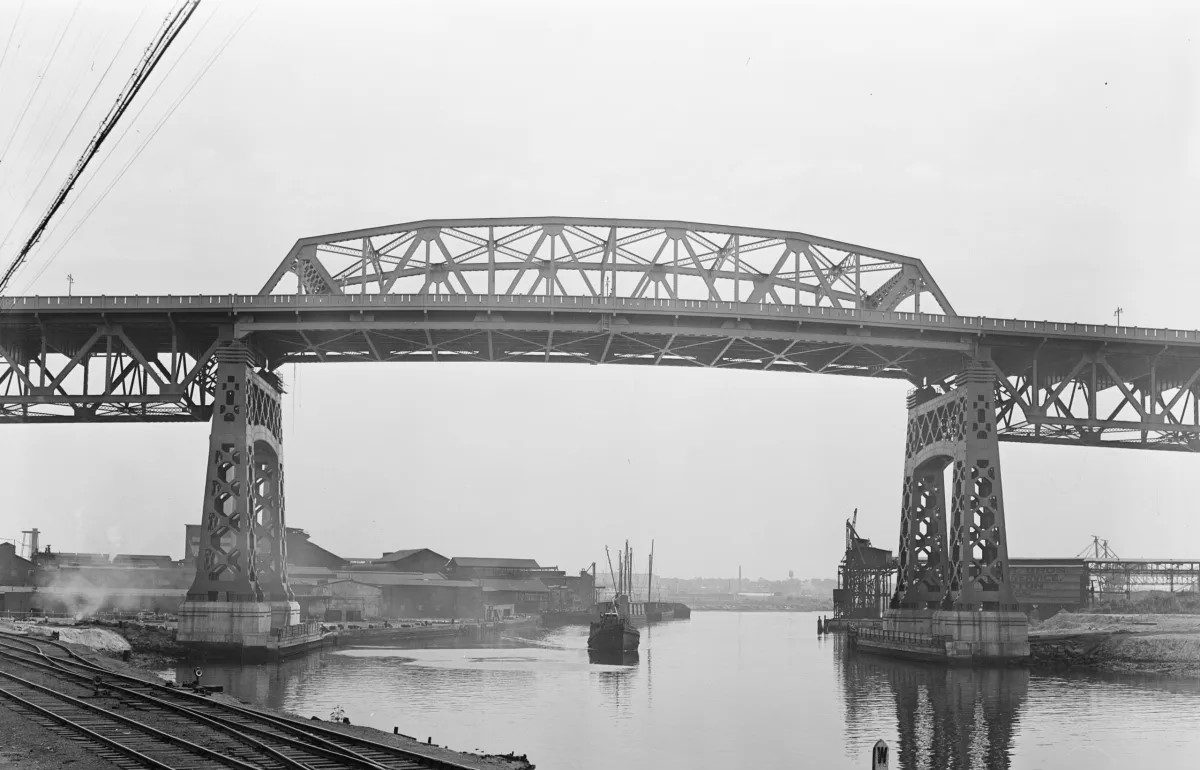
The 1939 bridge could handle up to 10,000 vehicles daily. By 2017, when the first cable-stayed span of the new bridge opened, traffic on the old steel structure had reached up to 180,000 vehicles daily of all sizes. This often caused significant congestion and required frequent maintenance. In 2014, the New York State Department of Transportation awarded a contract to the Swedish construction company Skanska to design and build the first half of the new bridge and to demolish the original structure using explosives.
To prevent debris from falling into the water during the old bridge’s demolition, Skanska decided to remove the entire main span (2.3 million kilograms) as a single block. The central span was lowered onto a barge using powerful jacks. However, most of the old bridge, including approach ramps, remained. The ramps rose over 30 meters above ground level.
To prepare for the explosive demolition, workers removed much of the asphalt, reducing weight and strategically weakening the steel superstructure. Six-meter-high soil mounds helped absorb vibrations from the fall. Nearby railroad tracks, underground fuel lines, sewage lines, and steel panels were protected. The explosive charges were wrapped in copper tubes, with detonating cords connecting them in a domino-like sequence. The gunpowder exploded through the tubes, sending energy through the steel, slicing it cleanly – as if a massive samurai sword had cut the structure.
Composed of Two Parts
The new, larger bridge consists of two segments: the first was installed in 2017, and the second in 2019. These two bridges mirror each other, creating the illusion of a single-tower cable-stayed bridge when viewed from above. Both are cable-stayed bridges, featuring pylons connected to the roadway by straight steel cables.
The new bridge is one of the first major cable-stayed bridges in the region and became the largest project for the New York State Department of Transportation. High Steel Structures used metallized structural steel for the main spans, requiring 6,249 tons of steel. Metallization protects the structure for up to 100 years, reducing future maintenance needs. Galvanization was used for some secondary elements, including cable anchor nodes. Due to the length and internal diameter of the anchor tubes, they could not be metallized, so they were galvanized instead.
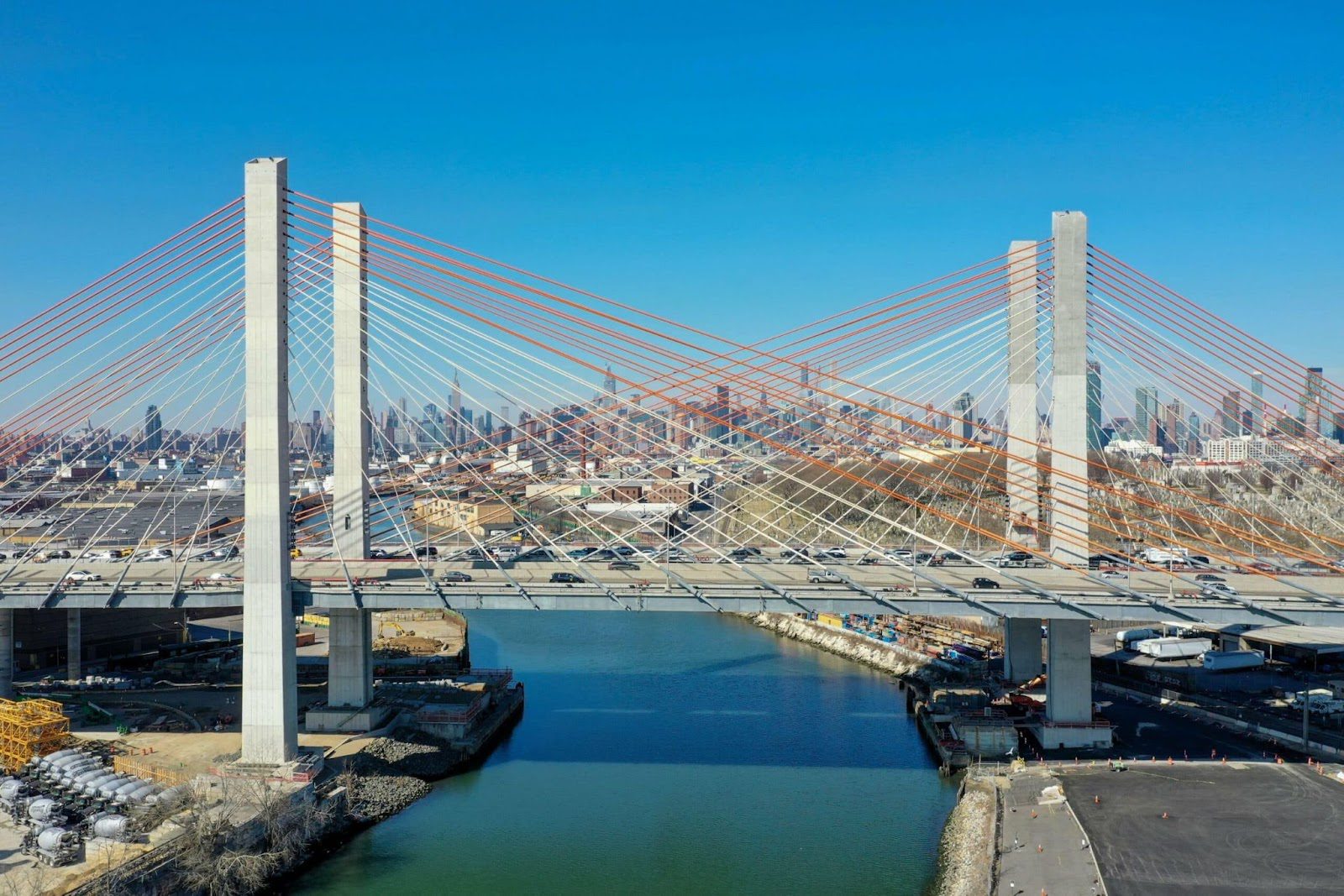
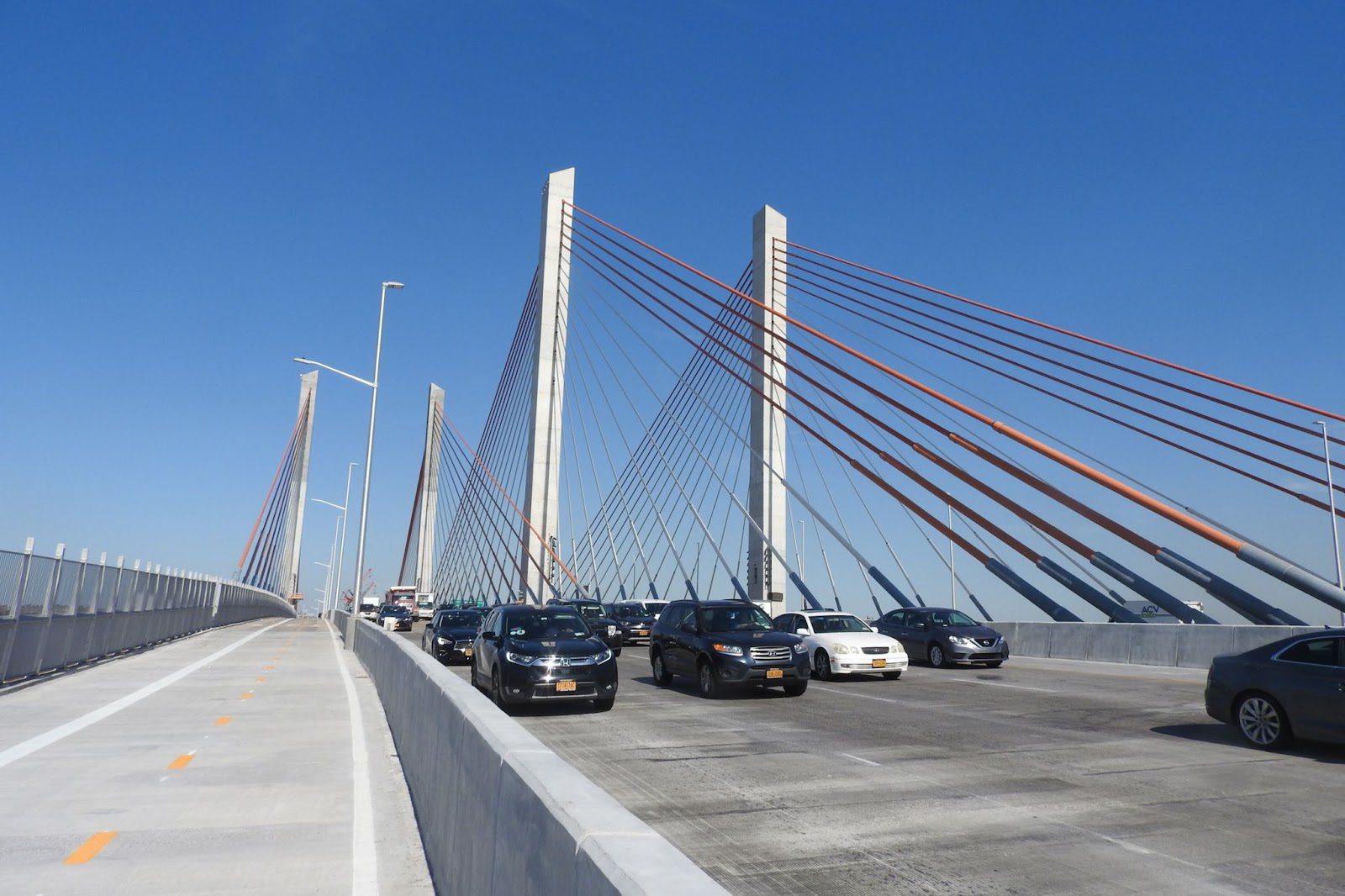
The new bridge improved traffic flow and provided a dedicated space for cyclists. A concrete and steel counterweight was designed and built at the rear span to balance the significant weight difference between the two segments. Hydraulic dampers were installed on each cable to absorb excess energy and reduce vibrations caused by strong winds or rain.
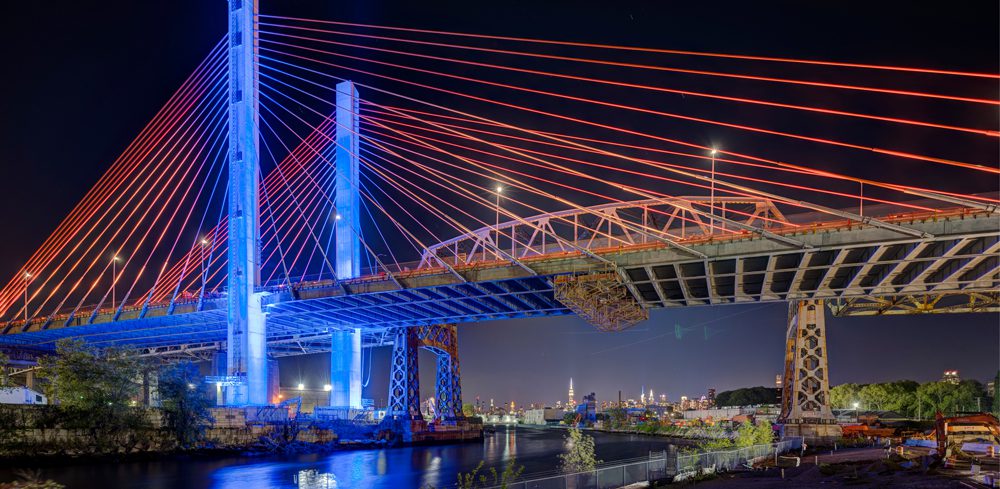
The road slope was lowered by 10 meters, allowing trucks and larger vehicles to maintain a steady speed when crossing. Three additional lanes provide wider shoulders and greater spacing between vehicles. The main span features a modern lighting system with multicolored LED lights illuminating the cables, programmable for dynamic light shows. Retaining walls along the lower approaches in Brooklyn and Queens are aesthetically enhanced with custom designs. Most importantly, the new bridge has reduced peak-hour traffic congestion by up to 65%.
Honoring a Hero of Two Nations
The bridge is named after Tadeusz Kosciuszko, a Polish-Belarusian who fought during the American Revolution. Later, he sought to inspire similar revolutionary fervor in his native Poland, leading to the fateful 1794 uprising. Under difficult geopolitical circumstances, Kosciuszko organized and led a rebellion against the Russian Empire. The Russians, with Prussian support, harshly suppressed the uprising, capturing Kosciuszko, who later died in exile. Poland faced a third and final partition in 1795, regaining independence only in 1918.
Nevertheless, Tadeusz Kosciuszko remains celebrated as an uncompromising hero among Americans and Poles alike, fighting for the freedom of both nations. He was a talented military leader, a skilled organizer, and an inspirational figure who rallied people to his cause.
Interesting Facts
- The cables of the Kosciuszko Bridge (189 miles in length) could wrap around Manhattan’s perimeter six times!
- The bridge’s LED lights can synchronize with music, creating light shows. It’s the first bridge in New York with this technology.
- The bridge contains enough concrete to cover the entire Central Park to a depth of approximately two inches.
- At the bridge’s grand opening, then-Governor Andrew Cuomo took the first test drive in a 1932 Packard car.
- The bridge is asymmetrical. The main span is 624 feet long, while the lighter, eastern span is just 377 feet.
- The Kosciuszko Bridge cost $555 million, making it the largest single contract in the history of the New York State Department of Transportation. It’s also the first major bridge built in New York in 50 years.
- Thanks to its orange cable elements, the bridge stands out on the city skyline.