

From its earliest days, aviation on Long Island grew and evolved, playing a crucial role in wartime and pioneering countless historic flights. Numerous aviation companies flourished here. To learn about the first flights on the island and many other fascinating facts, read on at queens-future.
How It All Began
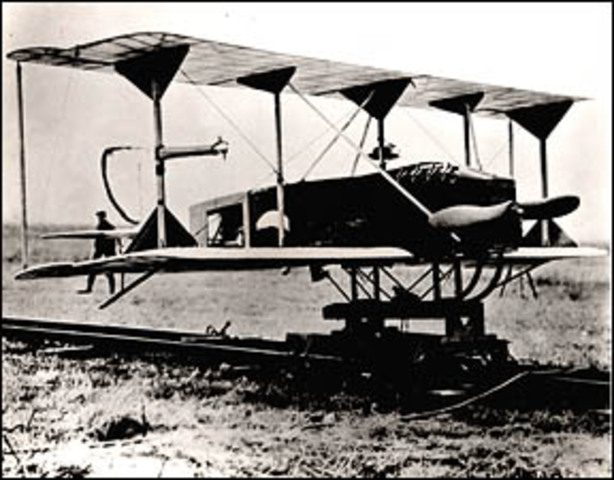
Long Island’s geography made it a natural fit for several airfields. Located in the southeastern part of New York State, it became an ideal hub for most transatlantic and continental routes. Furthermore, the central part of Nassau County, known as the Hempstead Plains, was the only natural prairie east of the Allegheny Mountains, making it a perfect flying field. The Hempstead Plains would become the scene of intense aviation activity for more than 50 years.
The first human flight on Long Island was in a hot air balloon, and this primitive form of aviation began to develop. The island’s most famous early flight occurred in 1873 when a Lilienthal-type glider took off from the cliffs along the north shore of Nassau.
By 1909, more significant flights were taking place from the Hempstead Plains in central Nassau. These were performed by the famous aviator Glenn Curtiss in his “Golden Flyer” biplane. By 1910, three airfields were operating on the Hempstead Plains, and Long Island residents began to build their own aircraft.
That same year, several flight schools and aviation factories opened. A pivotal event was the International Aviation Meet held in 1910 at Belmont Park.
The best aviators from across America and Europe came to Long Island to showcase their latest flying machines, compete, set records, and win awards.
A similar meet was held at the Nassau Boulevard Aerodrome in Garden City in 1911. This event featured the first official airmail service in the U.S. Then, in 1911, the first transcontinental flight was completed when Cal Rodgers flew a Wright biplane from Long Island to California in 49 days.
The Growth of Aviation on Long Island
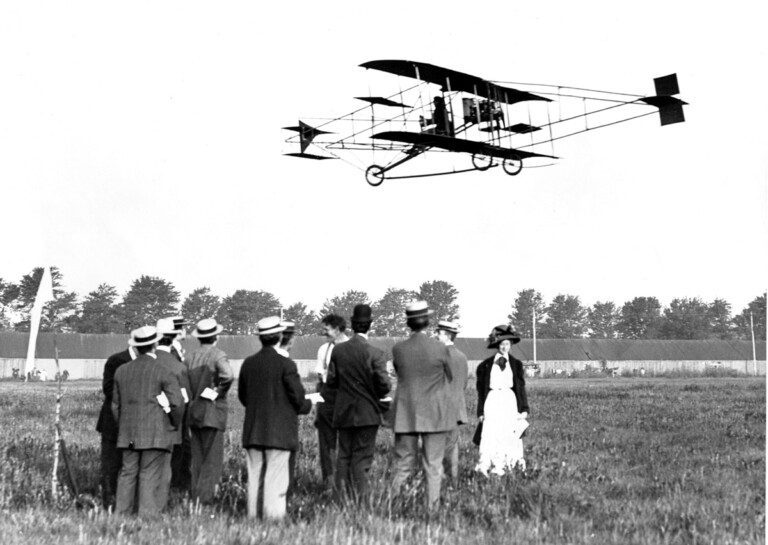
During World War I, Hazelhurst Field and Mitchel Field on the Hempstead Plains were primary American training centers for Army aviators. Alongside these training centers, factories were built to produce military aircraft.
The years between 1918 and 1939 were crucial for aviation’s development, as flying transformed into a major commercial industry. In 1918, Long Island was home to 20 aircraft manufacturing plants that made significant contributions to both American civil and military aviation.
In 1919, the first flight across the Atlantic Ocean was accomplished when a Navy Curtiss NC-4, built in Garden City, flew from Long Island to England with two intermediate stops. A second major flight was made by the British R-34 airship, which traveled from England to Long Island across the Atlantic.
In 1923, the first non-stop flight across America was made from Long Island to California. That year, major aircraft manufacturing companies were founded on the island: Curtiss and Sikorsky in Garden City, Sperry and Fairchild in Farmingdale, and Brunner-Winkle in Queens.
A critically important event was Charles Lindbergh’s 1927 flight from Roosevelt Field to Paris. This flight revolutionized aviation and was followed by many more transatlantic journeys.
During World War II, locally produced aircraft helped America achieve victory. Airplanes built on Long Island dominated many aspects of American fighter operations.
Throughout the war, two major companies, Grumman and Republic, dominated the local industry, primarily producing Navy biplane fighters.