

The borough of Queens has many bridges that connect it to the other boroughs of New York City. One bridge that is particularly noteworthy is the Queensboro. Read on at queens-future to learn about how the bridge was built and other fascinating facts.
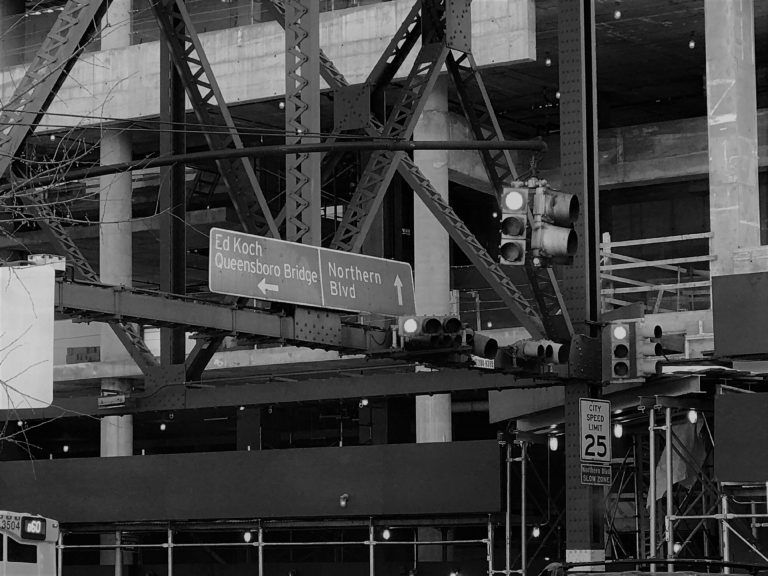
Before the Queensboro Bridge connected Queens to Manhattan, people traveling between the two boroughs used ferries to cross the East River. When the bridge was first built, it featured elevated railway tracks on the upper level and trolley lanes on the lower level. The Queensboro was the first bridge to connect Queens with Manhattan.
This stunning structure connects Midtown Manhattan with Long Island City in Queens. Every year, more than 1 million people cross the bridge, which features a unique architectural design.
Proposals to build the bridge were first discussed during the 19th century. It wasn’t until the turn of the century that a new organization, the New York City Department of Bridges, began to lay the groundwork and plan its construction. The department was led by Gustav Lindenthal in collaboration with architect Henry Hornbostel, who together developed the plans to begin building the Queensboro.
Construction lasted for over eight years, beginning in 1901 and finishing in 1909. The bridge officially opened to traffic on March 30, 1909, and to pedestrians on June 18 of the same year.
While the Queensboro may not be as famous as the Brooklyn Bridge, it is near and dear to the hearts of many New Yorkers. Although there are now many faster and more convenient ways to cross the East River, many people still choose to drive, bike, or walk across the Queensboro Bridge just to take in the beautiful views of the East River, Roosevelt Island, and Manhattan.
It is considered one of the longest bridges on the East River, with a total length of 7,449 feet, according to the New York City Department of Transportation.
Features of the Queensboro Bridge
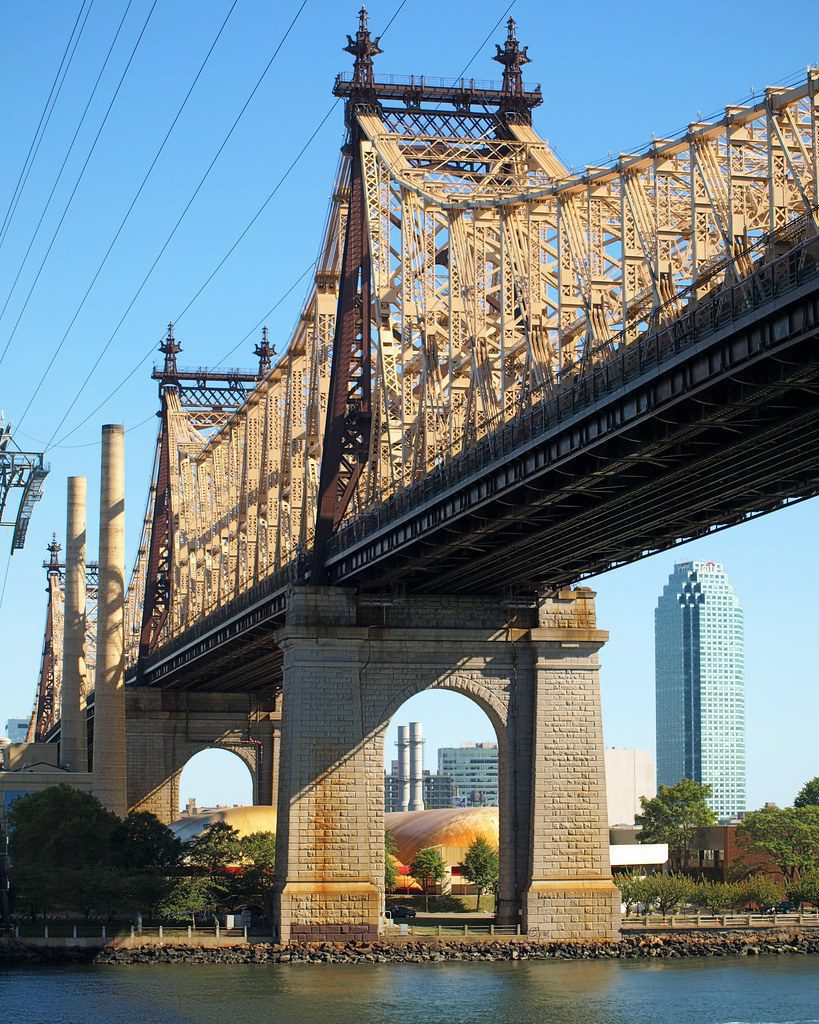
In the 1930s, the inner trolley tracks were removed and replaced with roadways. One of the main motivations for building the bridge was to open up the farmlands of Queens for residential development to meet the housing needs of Manhattan’s workforce.
Somewhat unusually, the bridge actually consists of three separate spans. One runs between Manhattan and Roosevelt Island, a second crosses over Roosevelt Island, and a third connects the island to Queens. Upon its completion, it was named the longest cantilever bridge in North America.
New Yorkers sometimes call the Queensboro Bridge “Hornbostel’s Erector Set” for its unpainted filigree of steel, nuts, and bolts. Although it was ridiculed at first, it has since entered the pantheon of iconic New York City bridges.
The Queensboro is a five-span cantilever truss bridge. It runs over 59th Street and consists of two levels. Drivers can use either the upper or lower level, though the upper level is often congested with traffic. To cross the bridge without traffic jams, it is best to go early in the morning. The upper level contains two traffic lanes, and the lower level also has two lanes.
In 2000, the north outer roadway was permanently converted into a pedestrian and bicycle path.
For many people, this bridge evokes a spirit of romanticism. The view of Manhattan from the bridge is breathtaking, and the best vantage point is from the upper level. The Queensboro also plays a significant role in culture. Perhaps its most direct representation in popular culture came from Paul Simon, who composed a song about it: “The 59th Street Bridge Song (Feelin’ Groovy).”
The Queensboro Bridge has also served as a filming location for world-famous movies.