

Flushing High School is a four-year public high school located in Flushing, a neighborhood in Queens. The school operates under the New York City Department of Education and actively integrates and advances IT technologies. Learn more about the school’s founding and its journey toward implementing IT innovations in this article on queens-future.
Founding History of the School
Flushing High School was founded in 1875 and is considered the oldest public school in Queens borough. The large building served as a municipal high school for some time, starting with only seven students in its first year. By 1878, enrollment had grown to over 100 students, prompting the state to allocate $3,500 for the school’s expansion.
In 1880, in addition to educating children, the school offered teacher training courses—the only school in Queens to do so. Education and books were free for borough residents interested in becoming teachers.
In 1902, the school board submitted a request to the local board of education to purchase additional land for the school. In July 1908, the board acquired land on Whitestone Avenue, and a project for a new five-story building, designed to accommodate 800 students, was developed.
Construction began in 1912, and in 1915, students moved into the new building, with John Clark appointed as principal. The school quickly gained popularity, attracting many students.
In 1991, the New York City Landmarks Preservation Commission designated the building as an architectural landmark, and in 1992, it was added to the National Register of Historic Places.
The Modern Flushing High School and Introduction of IT
Teachers at Flushing High School strive to create opportunities for students to grow and enhance their knowledge by developing specialized, comprehensive programs.
The school’s mission is to instill in students essential social skills necessary for future success in university education.
Today, students have the opportunity to delve deeper into subjects such as arts, foreign languages, programming, and mathematics.
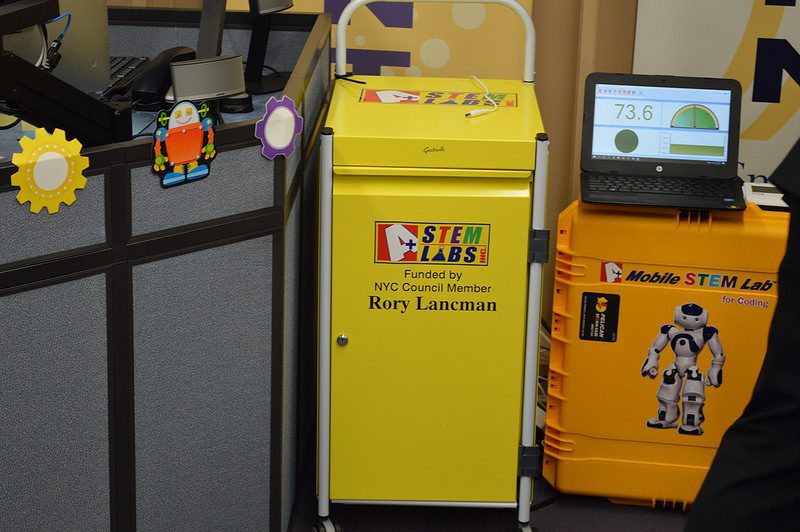
In 2017, a STEAM SmartLab computer lab and broadcasting studio were established at PS 201: The Discovery School to enhance practical programming skills.
Council Member Rory Lancman led the effort to fund and implement these resources into the educational process. The specialized SmartLab allows students to create and develop their own projects using 3D printing, software engineering, and robotics. For example, students in the lab can compose and deliver daily announcements to various classes.
These new resources have greatly benefited the school’s students and are utilized by both elementary and high school students.
Advantages of Learning in the Lab
The lab’s dynamic learning environment provides students with the chance to study programming and engage with innovative technologies. With this new equipment, the school has become a hub of technological growth, and students of all ages use these innovative tools daily in their studies.
Learning in the lab brings numerous advantages for students:
- Enhanced Learning through Modern Information Technology: Advanced technology offers students more substantial resources and optimizes information search.
- Increased Engagement: Educational videos and audio resources boost students’ engagement.
- Self-Assessment and Progress Monitoring: The lab includes testing and self-assessment tools to help students monitor their progress.
- Development of Logical Thinking: Robotics and programming encourage students to think critically and logically.
- Self-Expression and Creativity: Computer graphics, design, and animation provide students with a platform to create something unique and original.